
Most organisations don’t fail because people aren’t working hard.
They fail because effort is distributed unevenly across the system.
One part of the organisation may be extremely strong—execution, for example—while another part, such as clarity or engagement, quietly weakens. Over time, this imbalance shows up as confusion, firefighting, disengagement, slow decision-making, and leadership fatigue.This article introduces a four-quadrant model for building strong organisations and explains how leaders can use it as a diagnostic lens to identify gaps and take focused action.
Why Organisations Struggle Despite Good Intentions
Many leadership teams experience the same frustration:
- “We are busy all the time, but progress feels slow”
- “People are committed, yet alignment is missing”
- “Execution happens, but only through constant firefighting”
- “Engagement initiatives exist, but ownership is low”
These symptoms are rarely caused by individual capability issues. They are almost always system design issues.Strong organisations are not built by focusing on one dimension alone. They are built by balancing four critical enablers that work together.
The Four Quadrants of Organisational Strength
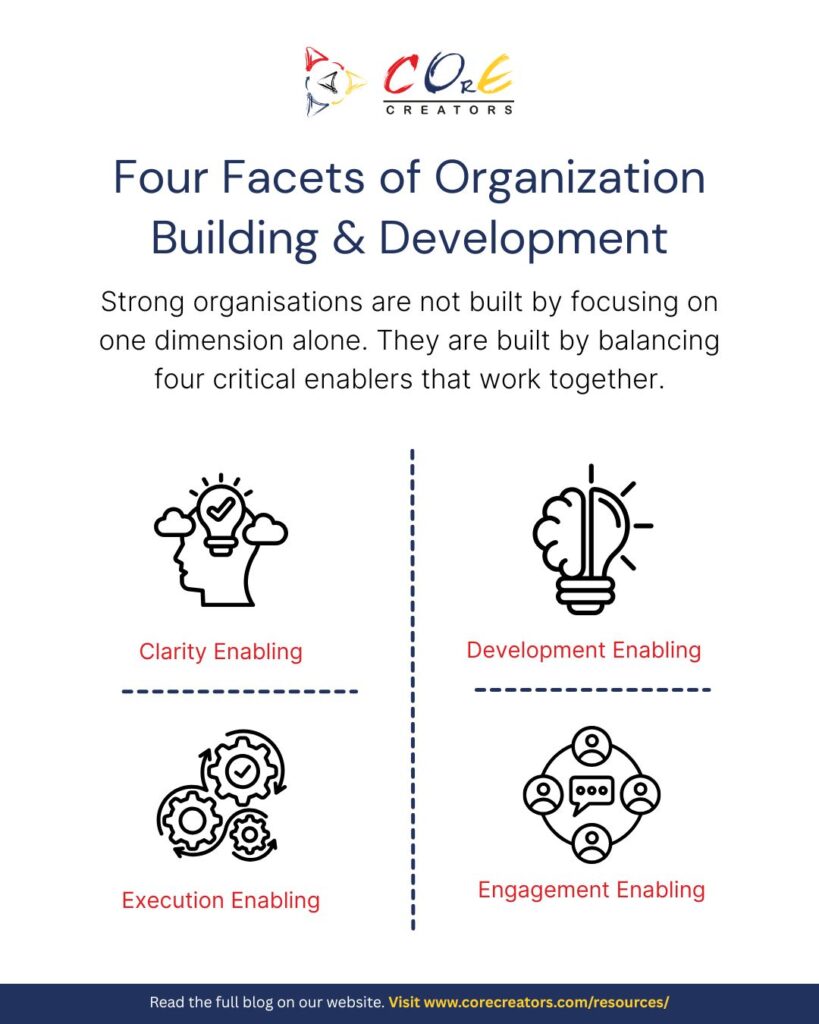
The four quadrants represent the minimum conditions required for sustainable organisational performance:
- Clarity Enabling
- Execution Enabling
- Development Enabling
- Engagement Enabling
When all four are present and aligned, organisations move with focus, energy, and momentum. When one or more are weak, performance becomes fragile.
Let’s look at each quadrant in detail.
1. Clarity Enabling
The Foundation of Alignment and Decision-Making
Clarity enabling answers the most fundamental organisational questions:
- Why do we exist?
- Who do we serve?
- What outcomes matter most right now?
- What are our priorities and non-priorities?
- How are decisions made?
What Clarity Enables
- Faster decision-making
- Reduced rework and duplication
- Confidence at all levels
- Fewer escalations to leadership
Clarity is not about control or micromanagement. It is about reducing ambiguity so people can act responsibly.
Signs Clarity Is Weak
- Teams interpret priorities differently
- Leaders keep repeating the same messages
- Decisions are revisited or reversed frequently
- People ask, “Is this really important?”
When clarity is missing, even highly capable teams struggle to execute effectively.
2. Execution Enabling
Turning Intent into Consistent Action
Execution enabling focuses on how work actually gets done.
It includes:
- Clear ownership and accountability
- Simple operating rhythms
- Practical metrics and feedback loops
- Coordination across functions
Execution fails not because people don’t want to deliver, but because the system makes delivery unnecessarily hard.
What Execution Enabling Looks Like
- Clear owners for outcomes, not just tasks
- Few, well-defined priorities
- Regular review and course correction
- Alignment between goals, resources, and timelines
Signs Execution Is Weak
- Constant firefighting and urgency
- Too many parallel initiatives
- Missed deadlines despite high effort
- Dependence on heroic individuals
Execution improves when systems support focus, rather than overload.
3. Development Enabling
Building Capability for Today and Tomorrow
Development enabling ensures the organisation is not just performing, but learning and growing.
It includes:
- Skill development
- Leadership capability building
- Reflection and learning mechanisms
- Safe feedback environments
Organisations that ignore development often perform well—until they suddenly don’t.
What Development Enables
- Adaptability in changing environments
- Strong leadership pipelines
- Reduced dependency on a few experts
- Sustainable growth
Signs Development Is Weak
- Same problems repeat every year
- Leaders are stretched but not growing
- Learning is treated as an “extra” activity
- Feedback is avoided or superficial
Without development, performance eventually plateaus.
4. Engagement Enabling
Creating Ownership, Energy, and Commitment
Engagement enabling focuses on how people experience the organisation.
It answers questions such as:
- Do people feel involved in decisions that affect them?
- Do they experience recognition and respect?
- Do they feel their contribution matters?
Engagement is not about perks or motivation campaigns.
It is about creating conditions where people choose to own outcomes.
What Engagement Enables
- Discretionary effort
- Psychological safety
- Commitment during uncertainty
- Stronger collaboration
Signs Engagement Is Weak
- Passive compliance instead of ownership
- Low participation in discussions
- Resistance to change
- “Us vs them” thinking
Engagement strengthens when people feel heard, valued, and involved.
A Simple Self-Diagnosis Checklist for Leaders
Use the questions below to identify where imbalance may exist.
Clarity Enabling
- Can most people clearly state current priorities?
- Are decision rights understood?
- Is strategy translated into practical focus?
Execution Enabling
- Are owners clearly accountable for outcomes?
- Do we review progress consistently?
- Are teams overloaded or focused?
Development Enabling
- Are leaders growing in capability?
- Do we learn from successes and failures?
- Is feedback safe and regular?
Engagement Enabling
- Do people feel involved in shaping outcomes?
- Is contribution recognised meaningfully?
- Is trust visible in everyday interactions?
Patterns across these answers will reveal where attention is needed most.
How Leaders Should Use This Model
This framework is not a diagnostic report card. It is a conversation tool.
Leaders can use it to:
- Reflect honestly on organisational health
- Identify leverage points for change
- Design targeted interventions instead of broad initiatives
- Align leadership teams around shared reality
The goal is not to “fix everything at once,” but to strengthen the weakest quadrant first.
Final Thoughts
Strong organisations are not built through slogans or isolated initiatives. They are built through intentional system design—where clarity, execution, development, and engagement reinforce one another. When leaders stop blaming people and start designing better systems, performance follows.